

Seiko Tisse: The Dainty Seiko Watch Made to Wear Like Jewellery
Brand Heritage · Seiko
Tissé is Seiko's bracelet first watch family: born in 1984 as an accessory like design, then explored through tiny cases, sculpted links, soft colour and jewellery proportions that still feel remarkably current.
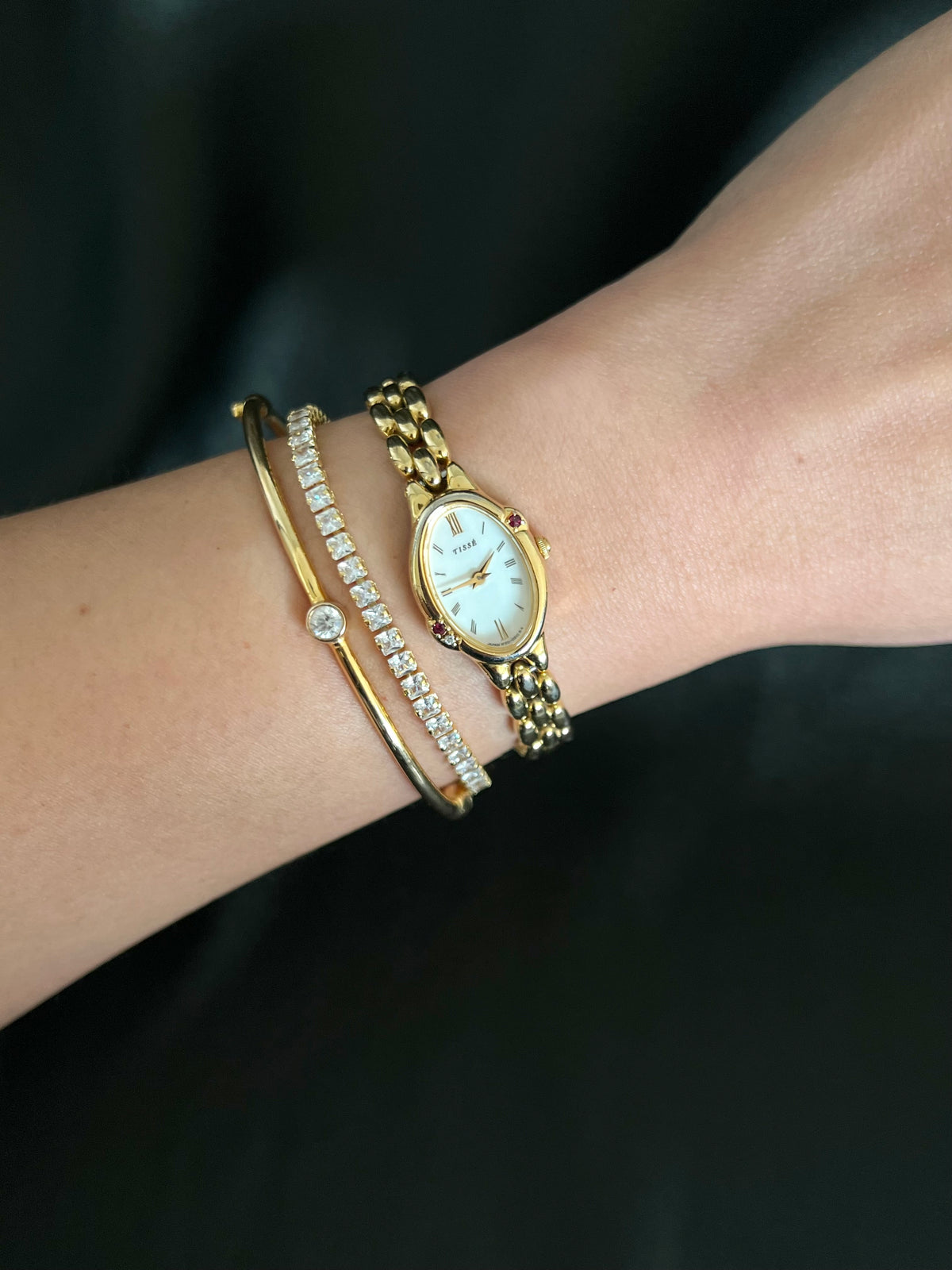
What Is Seiko Tissé?
A watch designed to sit closer to jewellery than hardware
The original Tissé idea was simple and unusually good: make the watch small enough that the bracelet can become the design. Instead of a conventional watch head with a strap attached, the case, links and clasp read as one continuous object on the wrist.
That idea explains the enormous variety that followed. Tissé can be round, oval, rectangular, gold tone, two tone, minimal, floral, stone accented or almost bangle like. The common thread is not one exact shape. It is the way the watch sits inside the jewellery language of the wrist.

The Design Story
The 1984 idea was ahead of its time
Seiko's design archive describes the first Tissé as an accessory like watch made possible by an exceptionally small quartz movement. The important result was visual rather than technical: Seiko could shrink the centre of the watch and let the bracelet take priority.
The original bead like form was designed to sit with an easier, looser attitude on the wrist. That is why the best Tissé pieces feel so natural beside a tennis bracelet, a slim bangle or a fine chain today. They were conceived as adornment from the beginning.
Tissé matters because it was never just a small Seiko. It was a different idea of how a watch could live on a woman's wrist.

Design Language
How to recognise the Tissé mood
The bracelet leads
Leaves, hearts, rice links, beads, rope textures and bangles often carry more personality than the dial itself.
Smallness is deliberate
A tiny face leaves visual room for jewellery. The scale is part of the design rather than a compromise.
Colour stays controlled
Mother of pearl, black, peach, ivory and champagne dials add mood while keeping the overall silhouette composed.


Visual Archive
Six more ways Tissé interpreted the jewellery watch
Rather than treating Tissé as one recognisable model, the archive makes more sense as a family of proportions and bracelet ideas. These pieces show how widely Seiko explored that premise.


Timeline
From 1984 design moment to modern rediscovery
Original Tissé appears
Seiko introduces a small jewellery watch centred on a bead like form and a relaxed bracelet wearing style.
The idea becomes a family
Round, oval, two tone and dressier bracelet designs expand the Tissé vocabulary without losing its petite scale.
Seiko revisits the concept
The Power Design Project reframes the loose fitting Tissé idea for a modern audience.
The design returns to production
A limited modern collection confirms that the original jewellery first concept still has relevance decades later.

Wrist Proportions
Do not judge a Tissé by case width alone
On a jewellery watch, the face is only one part of the proportion. A very small dial can still have real presence when the bracelet is broad, sculptural or bright. An elongated oval or rectangle can also look more substantial on the wrist than its width suggests.
For smaller wrists, the most flattering Tissé often has a tiny centre with a bracelet that follows the wrist rather than sitting stiffly across it. On a larger wrist, a looser bracelet fit can preserve the original jewellery feeling instead of making the watch look artificially tight.
- Look at the whole silhouette. Compare the case, bracelet width and link shape together.
- Check maximum wrist circumference. Integrated vintage bracelets can be far less forgiving than leather straps.
- Think about visual weight. A tiny dial can support a surprisingly expressive bracelet.
- Let shape change the rules. Teardrop, oval and rectangular cases wear differently from a simple round case.


Styling and Buying
Choose the Tissé by how you want the wrist to feel
For a clean single watch wrist
Choose an expressive bracelet, bangle or unusual case and let it stand alone. The watch itself supplies the jewellery.
For stacking
Pair a sculpted Tissé with one quieter neighbour. A fine tennis bracelet, narrow bangle or simple chain usually gives the watch enough room to remain visible.
For mixed metals
Two tone Tissé is a natural bridge between yellow gold and silver jewellery. It makes a mixed stack feel intentional rather than accidental.
Texture matters more than matching everything exactly. If the Tissé has a busy heart, leaf or rope bracelet, place something smooth beside it. If the watch is a clean bangle, a fine line of stones can add contrast without making the wrist noisy.
Fit matters just as much as styling. A Tissé should not be so loose that the face constantly falls underneath the wrist, but it does not need to be clamped down like a sports watch either. A little movement can suit the original bracelet like attitude beautifully.
For older plated pieces, avoid stacking them hard against heavy bangles that will repeatedly strike the case or bracelet. Fine jewellery gives the same visual effect with much less abrasion.


Tissé vs Exceline
Exceline is refinement. Tissé is adornment.
The two lines can overlap in size and dressiness, but they usually begin from different places. Exceline often asks how refined a small dress watch can become. Tissé more often asks how completely a watch can disappear into jewellery.
Choose Tissé if...
You care about sculptural links, unusual silhouettes, bracelet stacking and a watch that feels decorative before it feels technical.
Choose Exceline if...
You prefer a more composed dress watch with dial detail, slim proportion and a quieter relationship with the rest of your jewellery.

FAQ
Questions worth knowing

Is Seiko Tissé a model or a collection?
It is best treated as a family or collection name. The original 1984 Tissé was a specific design, but the name later appeared across many case shapes, bracelet styles and visual moods.
Are Tissé watches always tiny?
Most older examples are petite by modern standards, but the bracelet can create much more wrist presence than the dial measurement suggests. Judge the complete silhouette rather than the case width alone.
How should a Tissé fit for stacking?
Secure enough that the face stays mostly on top of the wrist, but not necessarily skin tight. If you stack it, use one or two finer pieces beside it and leave the most decorative Tissé bracelet room to be seen.
Can I mix gold and silver jewellery with Tissé?
Yes. Two tone Tissé is especially useful because it visually connects both metals. Even a single metal watch can work in a mixed stack when the shapes and textures feel related.
What does the calibre number mean?
The calibre is simply Seiko's technical code for the movement inside the watch. Codes such as 1F20, 1F21 or 4N21 can help with dating, servicing or parts research, but they tell you very little about how a Tissé looks or wears. For most buyers, bracelet fit, proportion, condition and design matter far more.
Is the modern Power Design Tissé the same as the older watches?
No. It is a modern reinterpretation of the original bracelet like idea rather than a direct continuation of every vintage Tissé design.
Continue Exploring