
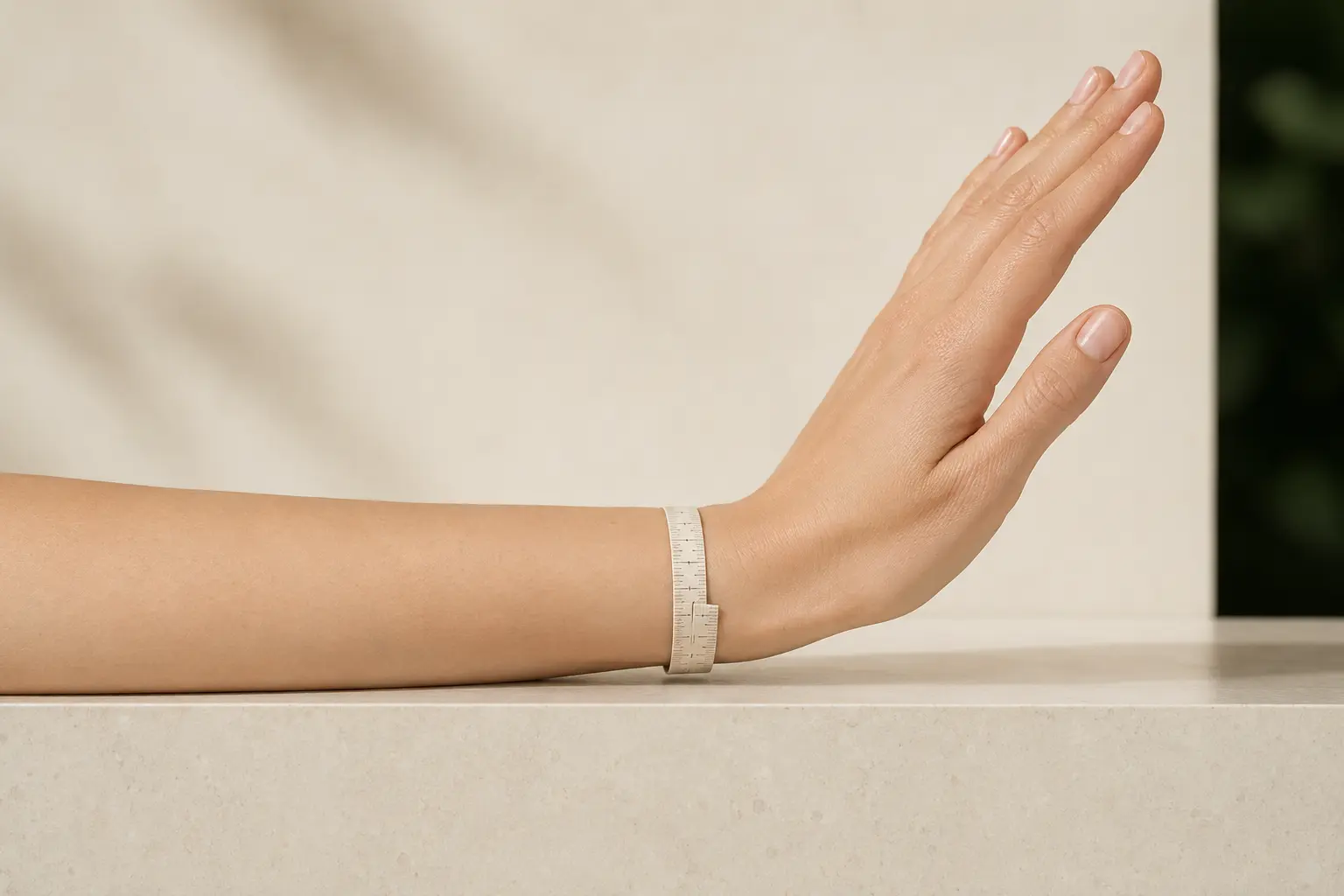
Move into comfortable dorsiflexion
Gently bend the back of your hand towards your forearm. Stop at the maximum position that feels natural and comfortable. Keep the forearm steady while you measure.
Gilded Hour reference guide · 02
One accurate number makes online watch shopping much easier. This guide shows exactly where the tape goes, what case diameter really measures and how to judge the fit of a petite vintage watch.
The short answer
Gently bend the back of your hand towards your forearm, bringing the wrist into comfortable dorsiflexion. Wrap a soft tape around the wrist just above the wrist bone, keep it flat without pulling tight and read where the tape meets zero. That conservative maximum reading is your wrist circumference, not your watch diameter.
01 · Wrist circumference
Measure with your wrist in comfortable dorsiflexion. Extending the wrist gives you the maximum working circumference at the wearing position, helping prevent the watch from becoming tight as your hand moves.
Gently bend the back of your hand towards your forearm. Stop at the maximum position that feels natural and comfortable. Keep the forearm steady while you measure.
Bring a soft tape around the full wrist. It should touch the skin all the way around without twisting, gaping or digging in. Do not add comfort allowance yet.
Read the circumference where the tape crosses zero. Record it in centimetres or millimetres, then measure once more. If the readings differ, take a third and use the middle result.
02 · Watch measurements
Wrist circumference tells you whether the strap or bracelet can close. Case measurements tell you how the watch itself will look and sit.
The complete distance around your wrist where the watch sits.
Usually shown in cm or mmThe case from outer edge to outer edge across the watch. The crown is not included.
Usually shown in mmThe top to bottom length of the case, including the lugs when present.
Usually shown in mmThe largest wrist circumference a closed bracelet or strap is expected to fit.
Check every individual listingThe measurement that needed fixing
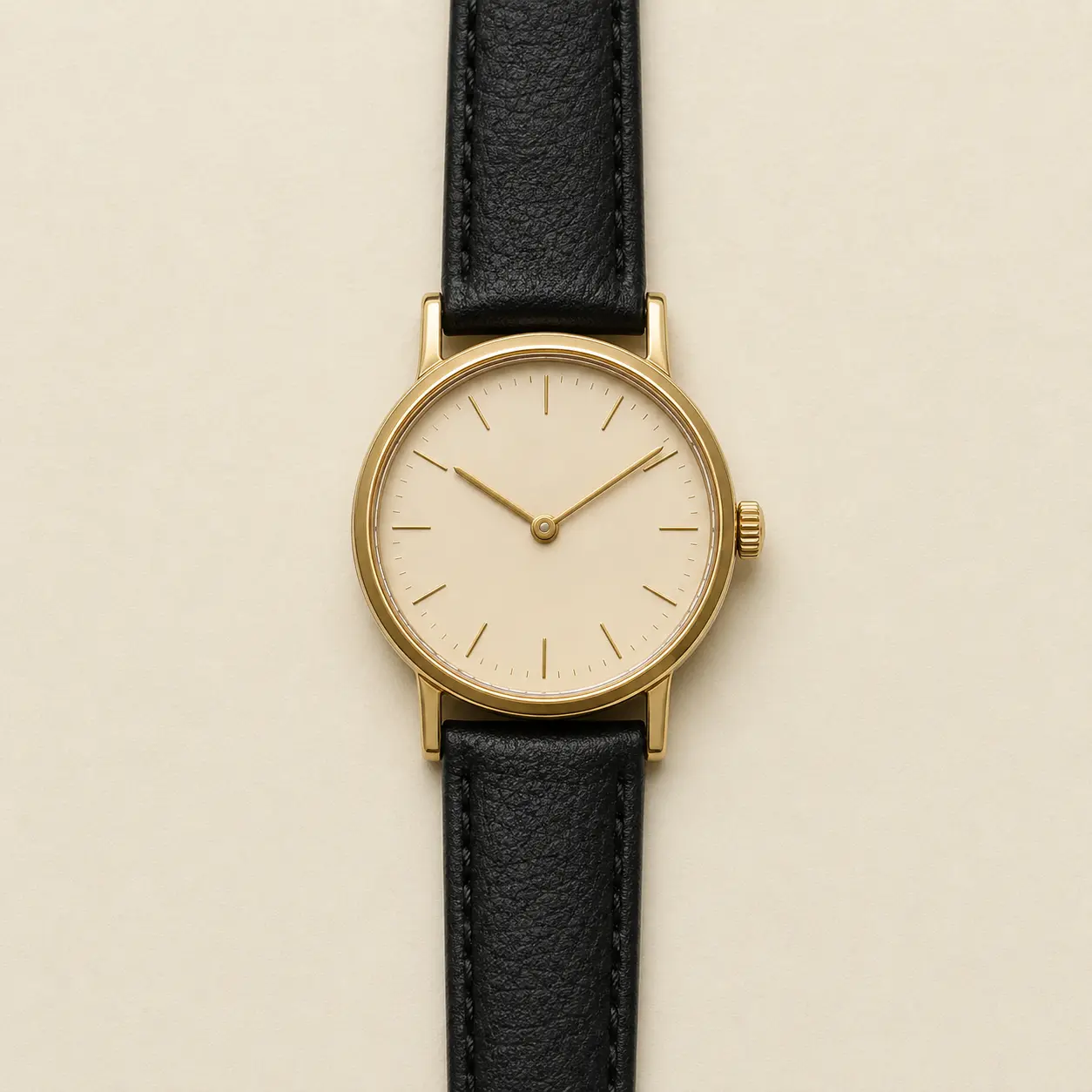
On a round watch, measure horizontally from the outer case edge at 9 o’clock to the outer case edge at 3 o’clock. Do not include the crown.
 Case diameter
Crown excluded
Case diameter
Crown excluded
Horizontal case width, excluding crown.
Record both width and top to bottom case length.
From the tip of the upper lug to the tip of the lower lug.
03 · Convert your result
Gilded Hour listings use centimetres for wrist fit and millimetres for the watch case. Use this converter if your tape shows inches.
Keep your original measurement. Conversions are rounded for readability, while a close fitting vintage bracelet may need millimetre level checking.
| Centimetres | Millimetres | Inches |
|---|---|---|
| 13.0 cm | 130 mm | 5.12 in |
| 13.5 cm | 135 mm | 5.31 in |
| 14.0 cm | 140 mm | 5.51 in |
| 14.5 cm | 145 mm | 5.71 in |
| 15.0 cm | 150 mm | 5.91 in |
| 15.5 cm | 155 mm | 6.10 in |
| 16.0 cm | 160 mm | 6.30 in |
| 16.5 cm | 165 mm | 6.50 in |
| 17.0 cm | 170 mm | 6.69 in |
| 17.5 cm | 175 mm | 6.89 in |
| 18.0 cm | 180 mm | 7.09 in |
| 18.5 cm | 185 mm | 7.28 in |
| 19.0 cm | 190 mm | 7.48 in |
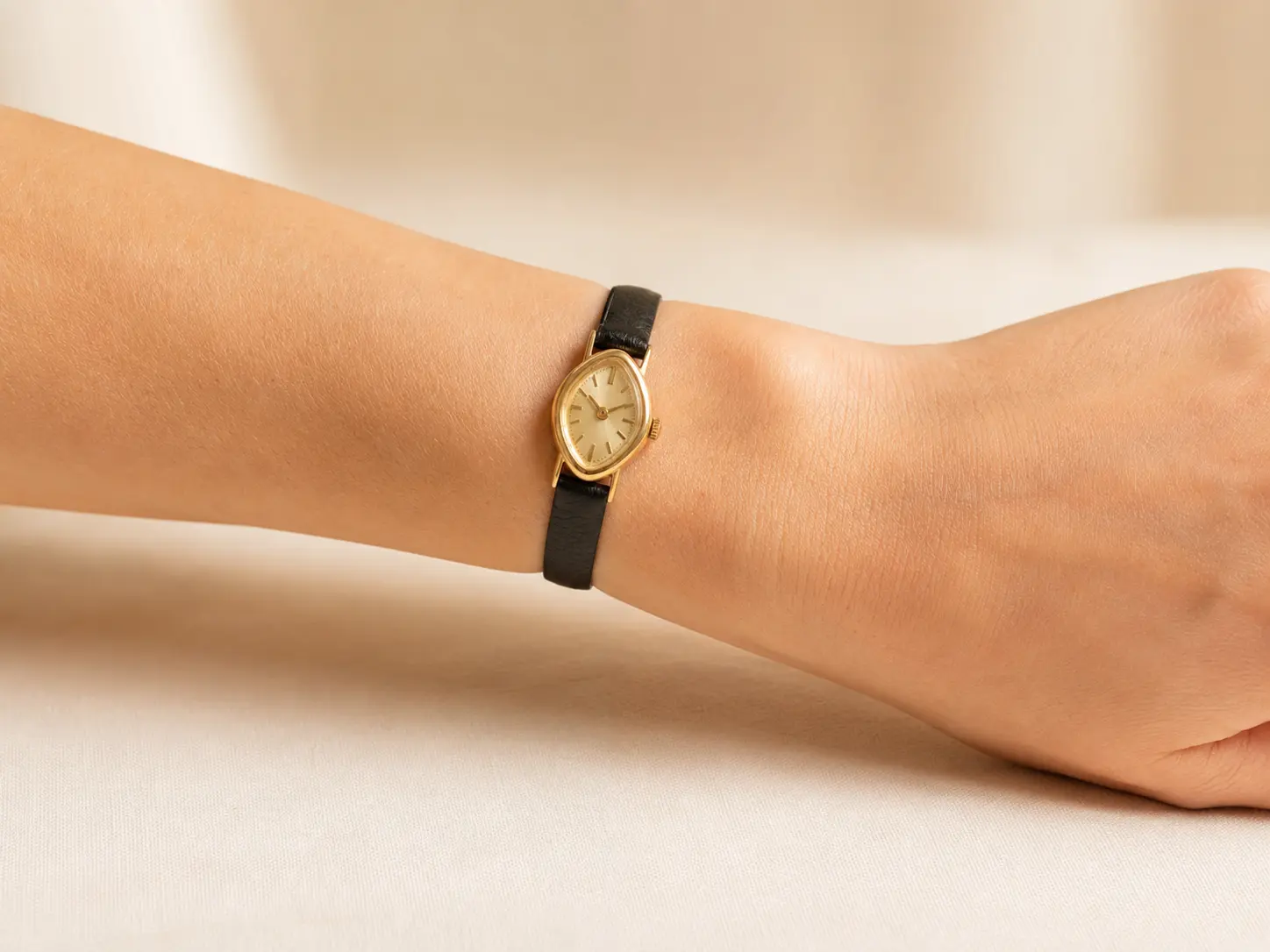 Secure, comfortable and able to move naturally
04 · Comfort and proportion
Secure enough to stay on top of the wrist. Comfortable enough that you forget it is there.
The bracelet pinches, leaves a deep mark or feels restrictive when your wrist warms.
The case stays mostly centred and a fingertip can pass under the strap without force.
The case repeatedly spins below the wrist or the bracelet catches on the hand.
05 · The Gilded Hour scale
Vintage women’s watches were often designed as jewellery first. Generic modern size charts can make them sound smaller than they wear. We use this simple case width scale across our collection.
Jewellery first. Petite cases that sit close to the skin and work beautifully in a wrist stack.
Shop small watches ↗Balanced vintage proportions with more dial presence while retaining a refined jewellery feel.
View available pieces ↗A stronger statement on the wrist. Shape, lugs and case length become especially important here.
Explore larger styles ↗06 · Buying vintage online
A leather strap has multiple positions, but the watch case itself takes up part of the total length. Compare your wrist with any stated fit range rather than adding the two strap pieces alone.
Links may have been removed during the life of a vintage watch. Some can be sized down easily, while sizing up depends on spare links being available.
Jewellery style bracelets may not use standard removable links. If your wrist is close to the listed maximum, contact us before buying so the construction can be checked.
07 · Avoid these mistakes
A ruler laid across the top of the wrist is not circumference. Wrap fully around the wrist for strap and bracelet fit.
Case diameter stops at the case edge. The crown at 3 o’clock is excluded.
Compressing the skin produces a smaller number and can lead to an uncomfortably tight bracelet.
Record your actual wrist. Fit preference is a separate decision, especially when a bracelet is professionally sized.
Case length, lugs and shape can make two watches with the same width wear very differently.
Vintage integrated and decorative bracelets may have little or no easy adjustment.
Frequently asked questions
Move your wrist into comfortable dorsiflexion by bending the back of your hand towards your forearm. Wrap a soft measuring tape where the watch will sit, usually just above the wrist bone. Keep the tape flat and snug without compressing the skin, then record where it meets zero.
Wrap a non stretchy strip of paper or ribbon around your wrist, mark where the ends meet, then lay it flat against a ruler. Avoid elastic string because it can stretch and understate your measurement.
Hold the wrist in comfortable dorsiflexion and measure close to the skin without compressing it. Do not add extra room to the number. Your preferred fit is considered separately when a bracelet is sized or a strap hole is selected.
Measure the exact place you intend to wear the watch. For most people this is on the top of the wrist, just above the wrist bone toward the elbow.
Case diameter is the horizontal width of a round watch case, measured from the outer case edge at 9 o’clock to the outer case edge at 3 o’clock. The crown is excluded.
Use case width from left to right and case length from top to bottom. Exclude the crown from width. If the lugs are distinct, also check the full lug to lug length.
No. Wrist circumference describes the distance around your wrist. Case size describes the watch itself, usually in millimetres. You need both to understand fit.
It should feel secure without pinching or leaving a deep mark. A bracelet may move slightly, but the case should not spin to the underside of your wrist. Comfort and personal preference still matter.
There is no single correct diameter. Wrist shape, case length, lugs and style all change how a watch wears. Gilded Hour calls cases up to 21mm small, over 21mm to 28mm medium, and over 28mm large within our vintage women’s collection.
Lug to lug is the top to bottom length of the case including its lugs. It helps show whether the watch will sit within the flatter top surface of your wrist rather than extending over its edges.
Sometimes. Removable links, clasp adjustment and bracelet construction vary by watch. Some integrated or decorative vintage bracelets have limited adjustment, so compare your wrist circumference with the listing and ask before buying if the fit is close.
Measured and ready
Every available Gilded Hour watch is photographed and described individually. Compare your wrist circumference with the listing, then ask us if a vintage bracelet needs a closer fit check.